Signed in as:
filler@godaddy.com


Conductive hearing loss occurs when sound is unable to travel efficiently through the outer or middle ear before reaching the inner ear. In other words, something is preventing sound from being transmitted normally through the hearing system.
Unlike some other types of hearing loss, conductive hearing loss is often c
Conductive hearing loss occurs when sound is unable to travel efficiently through the outer or middle ear before reaching the inner ear. In other words, something is preventing sound from being transmitted normally through the hearing system.
Unlike some other types of hearing loss, conductive hearing loss is often caused by a blockage, buildup, or medical condition affecting the outer or middle ear. In many cases, it can be temporary or medically treatable.
People with conductive hearing loss often describe sounds as:
Some individuals also experience a sensation of fullness, pressure, or blockage in the affected ear. Depending on the underlying cause, symptoms such as ear discomfort, drainage, or temporary changes in hearing may also occur.
The encouraging news is that conductive hearing loss is often temporary or medically treatable. Treatment depends on the underlying cause and may include:
If hearing loss remains after medical treatment—or if the condition cannot be fully corrected—hearing aids may be recommended to improve hearing, speech understanding, and everyday communication.
Did You Know?
Conductive hearing loss is often different from age-related hearing loss. Because it's frequently caused by a blockage or medical condition affecting the outer or middle ear, many cases can improve with appropriate medical treatment. If hearing loss persists after treatment, hearing aids may still help improve communication.
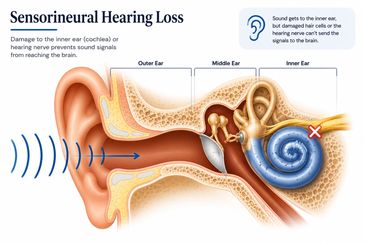
Sensorineural hearing loss is the most common type of hearing loss, affecting millions of adults worldwide. It occurs when the delicate hair cells inside the cochlea (inner ear) or the hearing nerve become damaged.
These tiny sensory hair cells play a vital role in hearing by converting sound vibrations into elec
Sensorineural hearing loss is the most common type of hearing loss, affecting millions of adults worldwide. It occurs when the delicate hair cells inside the cochlea (inner ear) or the hearing nerve become damaged.
These tiny sensory hair cells play a vital role in hearing by converting sound vibrations into electrical signals that travel to the brain. Once damaged, these hair cells do not naturally regenerate, making sensorineural hearing loss typically permanent.
Sensorineural hearing loss can develop for many reasons, including:
Many people with sensorineural hearing loss say:
"I can hear people talking, but I can't understand what they're saying."
This is one of the most common frustrations associated with hearing loss. While sounds may still be loud enough to hear, speech often loses its clarity. As a result, conversations can become especially challenging in restaurants, family gatherings, meetings, or other noisy environments.
High-pitched sounds—such as birds singing, children's voices, or speech sounds like S, F, and TH—are often the first to become more difficult to hear.
Other common signs of sensorineural hearing loss include:
Although sensorineural hearing loss is usually permanent, it can often be managed successfully with today's advanced hearing technology.
Modern hearing aids do much more than simply make sounds louder. When professionally selected, programmed, and adjusted to your individual hearing needs, they can help improve speech understanding, reduce listening effort, enhance comfort in many everyday environments, and automatically adapt to changing listening situations.
While hearing aids cannot restore normal hearing, many people experience significant improvements in communication, confidence, and overall quality of life when they receive appropriate hearing care and ongoing follow-up support.
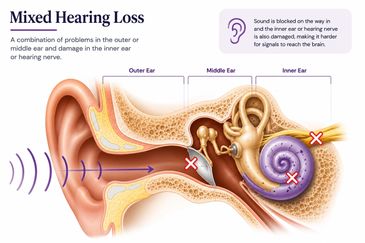
Mixed hearing loss is a combination of conductive hearing loss and sensorineural hearing loss. In other words, a person has both a condition affecting the outer or middle ear that interferes with sound transmission and permanent hearing loss involving the inner ear or hearing nerve.
Because two different types of hearing
Mixed hearing loss is a combination of conductive hearing loss and sensorineural hearing loss. In other words, a person has both a condition affecting the outer or middle ear that interferes with sound transmission and permanent hearing loss involving the inner ear or hearing nerve.
Because two different types of hearing loss are present, both components must be considered when determining the most appropriate course of care.
Mixed hearing loss can occur when someone with permanent sensorineural hearing loss also develops a conductive hearing problem, such as:
People with mixed hearing loss often experience characteristics of both conductive and sensorineural hearing loss. Sounds may seem quieter or muffled while speech can also become more difficult to understand clearly, particularly in noisy environments.
Common experiences may include:
Because symptoms can vary depending on the underlying conditions, a hearing evaluation* can help identify the type and degree of hearing loss. When findings suggest a condition that may require medical attention, referral to an appropriate medical professional may be recommended.
Treatment for mixed hearing loss depends on the conditions contributing to the hearing loss.
When possible, medical treatment may improve or resolve the conductive portion. Once any appropriate medical care has been addressed, hearing aids may be recommended to help manage the remaining permanent sensorineural hearing loss.
By appropriately addressing both components, many people can experience meaningful improvements in hearing, speech understanding, and everyday communication.
Not all hearing loss is the same, which is why there is no one-size-fits-all approach to hearing care. Identifying the type and degree of hearing loss provides important information for determining the most appropriate hearing care recommendations.
During a comprehensive hearing evaluation* at Empathy Hearing Aid Center, we may:
Whether your hearing loss is temporary, permanent, or a combination of both, understanding your hearing is an important first step toward making informed decisions about your hearing health.
Hearing evaluations are performed for the purpose of hearing aid selection, fitting, programming, and dispensing services.