• Home
  • About
    • Provided Services
    • Why Choose Us
    • Meet the Team
    • Service Area
    • Riverside
    • Eastvale/ Jurupa Valley
    • Norco
    • Corona
    • Chino/Chino Hills
    • Upland
    • Rancho Cucamonga
    • Fontana
    • Montclair
    • La Verne
    • Pomona
    • Rialto
    • San Bernardino
    • Redlands
    • Yucaipa
    • Loma Linda
    • Highland
    • Grand Terrace
    • Moreno Valley/ Perris
    • Menifee/ Murrieta
    • Diamond Bar
    • Glendora
    • Lake Elsinore
  • Hearing Solutions
    • Hearing Aid Solutions
    • Hearing Aid Styles
    • Hearing Aid Repairs
  • Resources
    • FAQ
    • Family Support
    • Third Party Insurance
    • Tinnitus
    • Preventing Hearing Loss
    • Senior Living Facilities
    • Hearing Protection
    • Hearing Loss+Brain Health
    • Maintenance & Care
  • Shop
  • Blog
  • Contact Us
  • More
    • Home
    • About
      • Provided Services
      • Why Choose Us
      • Meet the Team
      • Service Area
      • Riverside
      • Eastvale/ Jurupa Valley
      • Norco
      • Corona
      • Chino/Chino Hills
      • Upland
      • Rancho Cucamonga
      • Fontana
      • Montclair
      • La Verne
      • Pomona
      • Rialto
      • San Bernardino
      • Redlands
      • Yucaipa
      • Loma Linda
      • Highland
      • Grand Terrace
      • Moreno Valley/ Perris
      • Menifee/ Murrieta
      • Diamond Bar
      • Glendora
      • Lake Elsinore
    • Hearing Solutions
      • Hearing Aid Solutions
      • Hearing Aid Styles
      • Hearing Aid Repairs
    • Resources
      • FAQ
      • Family Support
      • Third Party Insurance
      • Tinnitus
      • Preventing Hearing Loss
      • Senior Living Facilities
      • Hearing Protection
      • Hearing Loss+Brain Health
      • Maintenance & Care
    • Shop
    • Blog
    • Contact Us
  • Sign In
  • Create Account

  • Orders
  • My Account
  • Signed in as:

  • filler@godaddy.com


  • Orders
  • My Account
  • Sign out

Signed in as:

filler@godaddy.com

  • Home
  • About
    • Provided Services
    • Why Choose Us
    • Meet the Team
    • Service Area
    • Riverside
    • Eastvale/ Jurupa Valley
    • Norco
    • Corona
    • Chino/Chino Hills
    • Upland
    • Rancho Cucamonga
    • Fontana
    • Montclair
    • La Verne
    • Pomona
    • Rialto
    • San Bernardino
    • Redlands
    • Yucaipa
    • Loma Linda
    • Highland
    • Grand Terrace
    • Moreno Valley/ Perris
    • Menifee/ Murrieta
    • Diamond Bar
    • Glendora
    • Lake Elsinore
  • Hearing Solutions
    • Hearing Aid Solutions
    • Hearing Aid Styles
    • Hearing Aid Repairs
  • Resources
    • FAQ
    • Family Support
    • Third Party Insurance
    • Tinnitus
    • Preventing Hearing Loss
    • Senior Living Facilities
    • Hearing Protection
    • Hearing Loss+Brain Health
    • Maintenance & Care
  • Shop
  • Blog
  • Contact Us

Account


  • Orders
  • My Account
  • Sign out


  • Sign In
  • Orders
  • My Account

Understanding the Different Types of Hearing Loss

Not all hearing loss is the same. In fact, hearing loss can affect different parts of the hearing system, occur for many different reasons, and require different approaches to treatment. Some types of hearing loss are temporary and may improve with medical treatment, while others are permanent and can often be successfully managed with today's advanced hearing technology. Because every person's hearing is unique, identifying the type and degree of hearing loss is one of the most important steps in developing the most appropriate hearing care plan. During a comprehensive hearing evaluation*, your hearing care professional performs a series of tests to better understand how you're hearing, where the hearing loss is occurring, and how it may be affecting your ability to communicate. This information helps guide personalized recommendations based on your individual hearing needs and lifestyle. The three primary types of hearing loss are Conductive Hearing Loss - Occurs when sound is blocked or cannot travel efficiently through the outer or middle ear. Sensorineural Hearing Loss - Occurs when the delicate structures of the inner ear or hearing nerve become damaged. Mixed Hearing Loss - A combination of both conductive and sensorineural hearing loss. Understanding these differences can help you better understand your hearing, your test results, and the treatment options that may be available.* Hearing evaluations* are performed for the purpose of selecting, fitting, and dispensing hearing aids.

*Hearing evaluations are performed for the purpose of hearing aid selection, fitting, programming, and dispensing services.


Contact us

Ways to Help

Conductive Hearing Loss

Sensorineural Hearing Loss

Sensorineural Hearing Loss

Conductive hearing loss occurs when sound is unable to travel efficiently through the outer or middle ear before reaching the inner ear. In other words, something is preventing sound from being transmitted normally through the hearing system.

Unlike some other types of hearing loss, conductive hearing loss is often caused by a blockage, bu

Conductive hearing loss occurs when sound is unable to travel efficiently through the outer or middle ear before reaching the inner ear. In other words, something is preventing sound from being transmitted normally through the hearing system.

Unlike some other types of hearing loss, conductive hearing loss is often caused by a blockage, buildup, or medical condition affecting the outer or middle ear. In many cases, it can be temporary or medically treatable.


Common causes include:

  • Earwax buildup
  • Ear infections
  • Fluid behind the eardrum
  • A perforated (ruptured) eardrum
  • Damage or stiffness of the tiny bones in the middle ear
  • Foreign objects in the ear canal
  • Congenital abnormalities affecting the ear


What you may experience

People with conductive hearing loss often

describe sounds as:

  • Quiet or softer than normal
  • Muffled
  • Distant
  • Difficult to hear, but often clearer when the volume is increased

Some individuals also experience a sensation of fullness, pressure, or blockage in the affected ear. Depending on the underlying cause, symptoms such as ear discomfort, drainage, or temporary changes in hearing may also occur.


Treatment options

The encouraging news is that conductive hearing loss is often temporary or medically treatable. Treatment depends on the underlying cause and may include:

  • Professional earwax removal
  • Medication to treat an ear infection or inflammation
  • Medical evaluation by a physician or ear, nose, and throat (ENT) specialist
  • Surgical treatment for certain middle ear conditions, when appropriate

If hearing loss remains after medical treatment-or if the condition cannot be fully corrected-hearing aids may be recommended to improve hearing, speech understanding, and everyday communication.


Did You Know?

Conductive hearing loss is often different from age-related hearing loss, Because it's frequently caused by a blockage or medical condition affecting the outer or middle ear, many cases can improve with appropriate medical treatment. If hearing loss persists after treatment, hearing aids may still help improve communication.

Sensorineural Hearing Loss

Sensorineural Hearing Loss

Sensorineural Hearing Loss

Sensorineural hearing loss is the most common type of hearing loss, affecting millions of adults worldwide. It occurs when the delicate hair cells inside the cochlea (inner ear) or the hearing nerve become damaged.

These tiny sensory hair cells play a vital role in hearing by converting sound vibrations into electrical signals that travel 

Sensorineural hearing loss is the most common type of hearing loss, affecting millions of adults worldwide. It occurs when the delicate hair cells inside the cochlea (inner ear) or the hearing nerve become damaged.

These tiny sensory hair cells play a vital role in hearing by converting sound vibrations into electrical signals that travel to the brain. Once damaged, these hair cells do not naturally regenerate, making sensorineural hearing loss typically permanent.


Common Causes of Sensorineural

Sensorineural hearing loss can develop for many reasons, including:

  • Natural age-related hearing loss (presbycusis)
  • Long-term exposure to loud noise
  • Genetic factors
  • Certain medications that may affect hearing
  • Illnesses or infections
  • Head trauma
  • Chronic health conditions, such as diabetes or cardiovascular disease

What You May Experience

Many people with sensorineural hearing loss say:

"I can hear people talking, but I can't I understand what they're saying."

This is one of the most common frustrations associated with hearing loss. While sounds may still be loud enough to hear, speech often loses its clarity. As a result, conversations can become especially challenging in restaurants, family gatherings, meetings, or other noisy environments.

High-pitched sounds-such as birds singing, children's voices, or speech sounds like S, F, and TH-are often the first to become more difficult to hear.

Other common signs of sensorineural hearing loss include:

  • Frequently asking others to repeat themselves
  • Turning up the television volume
  • Difficulty hearing on the telephone
  • Feeling mentally fatigued after conversations
  • Ringing or buzzing in the ears (tinnitus)

Treatment Options

Although sensorineural hearing loss is usually permanent, it can often be managed successfully with today's advanced hearing technology.

Modern hearing aids do much more than simply make sounds louder. When professionally selected, programmed, and adjusted to your individual hearing needs, they can help improve speech understanding, reduce listening effort, enhance comfort in many everyday environments, and automatically adapt to changing listening situations.

While hearing aids cannot restore normal hearing, many people experience significant improvements in communication, confidence, and overall quality of life when they receive appropriate hearing care and ongoing follow-up support.

Mixed Hearing Loss

Sensorineural Hearing Loss

Mixed Hearing Loss

Mixed hearing loss is a combination of conductive hearing loss and sensorineural hearing loss. In other words, a person has both a condition affecting the outer or middle ear that interferes with sound transmission and permanent hearing loss involving the inner ear or hearing nerve.

Because two different types of hearing loss are present, 

Mixed hearing loss is a combination of conductive hearing loss and sensorineural hearing loss. In other words, a person has both a condition affecting the outer or middle ear that interferes with sound transmission and permanent hearing loss involving the inner ear or hearing nerve.

Because two different types of hearing loss are present, both components must be considered when determining the most appropriate course of care.


Common Causes of Mixed Hearing Loss

Mixed hearing loss can occur when someone with permanent sensorineural hearing loss also develops a conductive hearing problem, such as:

  • Age-related hearing loss combined with chronic ear infections
  • Earwax buildup in someone who already has permanent hearing loss
  • Middle ear disease occurring alongside inner ear damage
  • A perforated (ruptured) eardrum in addition to age-related or noise-induced hearing loss
  • Other conditions affecting both the middle and inner ear

What You May Experience

People with mixed hearing loss often experience characteristics of both conductive and sensorineural hearing loss. Sounds may seem quieter or muffled while speech can also become more difficult to understand clearly, particularly in noisy environments.

Common experiences may include:

  • Muffled or reduced hearing
  • Difficulty understanding conversations


• Frequently asking others to repeat themselves


Common experiences may include:

  • Muffled or reduced hearing
  • Difficulty understanding conversations
  • Frequently asking others to repeat themselves
  • Trouble hearing in restaurants or group settings
  • Increasing the television or phone volume
  • A sensation of fullness or pressure in the ear when a conductive condition is present

Because symptoms can vary depending on the underlying conditions, a hearing evaluation* can help identify the type and degree of hearing loss. When findings suggest a condition that may require medical attention, referral to an appropriate medical professional may be recommended.


Treatment Options

Treatment for mixed hearing loss depends on the conditions contributing to the hearing loss.

When possible, medical treatment may improve or resolve the conductive portion. Once any appropriate medical care has been addressed, hearing aids may be recommended to help manage the remaining permanent sensorineural hearing loss.

By appropriately addressing both components, many people can experience meaningful improvements in hearing, speech understanding, and everyday communication.


Why Identifying Your Hearing Loss Matters

Not all hearing loss is the same, which is why there is no one-size-fits-all approach to hearing care. Identifying the type and degree of hearing loss provides important information for determining the most appropriate hearing care recommendations. During a comprehensive hearing evaluation*

At Empathy Hearing Aid Center, we may:

  • Examine your ears for visible concerns
  • Measure how well each ear hears different pitches and levels of sound
  • Evaluate your ability to understand speech
  • Determine the type and degree of hearing loss
  • Review your results in clear, easy-to-understand terms
  • Discuss appropriate hearing care options and answer your questions
  • Recommend medical evaluation.

when findings indicate that additional medical care may be appropriate

Whether your hearing loss is temporary, permanent, or a combination of both, understanding your hearing is an important first step toward making informed decisions about your hearing health.

Hearing evaluations are performed for the purpose of hearing aid selection, fitting, programming, and dispensing services.

BETTER HEARING STARTS WITH UNDERSTANDING

Our Mission

Understanding the type and cause of your hearing loss is the first step toward improving your hearing and communication. Whether your hearing changes are related to aging, noise exposure, a medical condition, or another factor, a hearing evaluation" can provide information used for hearing-aid selection and fitting.If you or a loved one has noticed changes in hearing, you don't have to navigate the journey alone.At Empathy Hearing Aid Center, we're committed to providing compassionate, personalized hearing care in a comfortable, supportive environment. Our goal is to help you reconnect with conversations, strengthen relationships, and enjoy the confidence that comes from hearing your best.Because better hearing isn't just about hearing more-it's about staying connected to the people and moments that matter most. Ready to take the first step? Contact us today to schedule your hearing evaluation" and learn more about your hearing health.

contact us

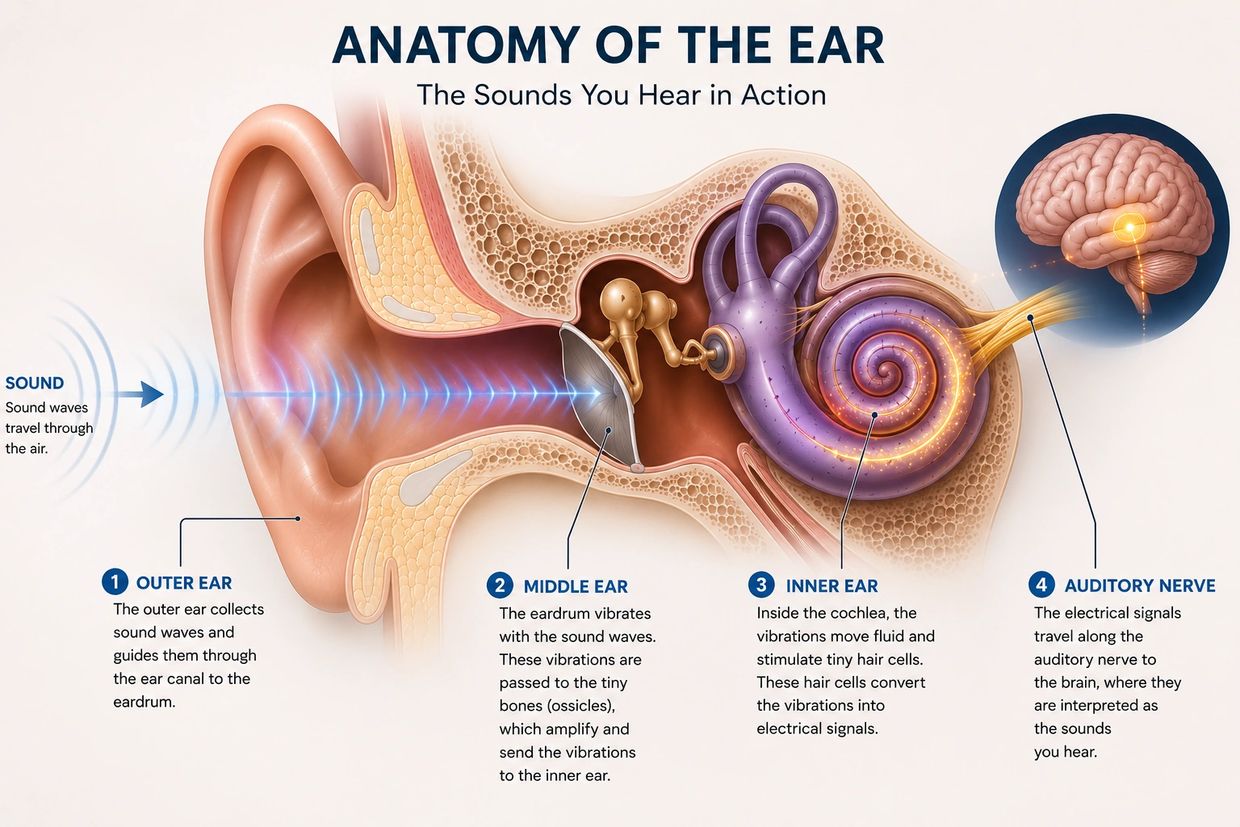
THE AMAZING PROCESS OF HEARING

Hearing is something most of us rarely think about-until it begins to change. Every conversation, every favorite song, every laugh from a grandchild, and every bird singing outside begins as a simple sound wave. In just a fraction of a second, that sound travels through an incredible system inside your ears before your brain recognizes and understands it.

Hearing is much more than simply detecting sound. It's a complex partnership between your ears and your brain that allows you to communicate, stay aware of your surroundings, and remain connected to the people and moments that matter most.

Let's take a look at how this amazing process works.

Step 1: Sound Enters the Ear

Everything begins with sound waves traveling through the air. Your outer ear acts like a natural funnel, collecting these sound waves and directing them down the ear canal toward the eardrum.

Although this seems simple, it's the first important step in capturing the sounds around you.

Step 2: The Eardrum & Middle Ear Go to Work

When sound waves reach the eardrum, it begins to vibrate. Those vibrations are then passed to three tiny bones inside the middle ear- the smallest bones in the human body.

These tiny bones work together like a miniature amplifier, increasing the strength of the vibrations before sending them into the inner ear.

Without this amplification, many everyday sounds would be much harder to hear clearly.

Step 3: The Cochlea Converts Sound into Nerve Signals

The vibrations now enter the cochlea, a small spiral-shaped organ located in the inner ear.

Inside the cochlea are thousands of delicate sensory hair cells. As sound vibrations move through the fluid inside the cochlea, these tiny hair cells bend and create electrical signals.

Each group of hair cells responds to different pitches-from deep bass sounds to high-pitched speech sounds-allowing you to hear the wide variety of sounds that make up everyday life.

These remarkable hair cells perform one of the most important jobs in hearing: converting sound into. electrical information vour brain can understand.

Step 4: Your Brain Makes Sense of Sound

The electrical signals travel from the cochlea along the hearing (auditory) nerve to the brain.

This is where hearing truly happens. Your brain instantly organizes and interprets these signals, allowing you to recognize voices, understand words, enjoy music, detect warning sounds, and determine where sounds are coming from. All of this happens in less than a second.

Although we often think we "hear" with our ears, it's actually your brain that gives sound its meaning.


Why Speech Becomes Difficult to Understand

One of the most common things people say is:

"I can hear people talking, but I can't understand what they're saying."

This happens because hearing isn't simply about making sounds louder.When the tiny hair cells inside the cochlea become damaged, certain speech sounds-particularly higher-pitched sounds like S, F, TH, and SH-may no longer be heard clearly.

Even if voices seem loud enough, missing these important speech sounds makes conversations much more difficult to understand, especially in restaurants, family gatherings, or other noisy environments.

This is why hearing loss often affects clarity before it affects volume.


What Happens When Hearing Loss Occurs?

Hearing loss occurs when one or more parts of the hearing system can no longer transmit or process sound as effectively as they once did. Depending on where the problem occurs, sounds may become softer, muffled, distorted, or more difficult for the brain to understand.

This is why hearing loss isn't always as simple as "not hearing loudly enough." A person may still hear someone speaking but miss important parts of words, making it seem as though people are mumbling or not speaking clearly. These difficulties often become even more noticeable when there is background noise or several people are talking at once.


Better Hearing Begins with Understanding

Understanding how hearing works can make it easier to understand why hearing loss affects much more than volume. Hearing involves the entire pathway from the outer ear to the brain, and changes anywhere along that pathway can affect how clearly we experience the sounds and conversations around us.

This also helps explain why two people with similar hearing test results may experience hearing loss differently. Speech understanding, listening environments, the type and degree of hearing loss, and many other individual factors can influence everyday communication.

If you or someone you love has noticed changes in hearing, a comprehensive hearing evaluation* can help identify the type and degree of hearing loss and provide a clearer picture of how those changes may be affecting communication.

The more you understand about your hearing, the better prepared you are to protect it, recognize changes, and make informed decisions about your hearing health.


*Hearing evaluations are performed for the purpose of hearing aid selection, fitting, programming, and dispensing services.

HEARING LOSS & BRAIN HEALTH

The Connection Between Hearing and Brain Health

Your ears and your brain work together every second of the day to help you understand the world around you. While your ears collect sound, it's your brain that processes those sounds into meaningful information-allowing you to recognize voices, understand conversations, enjoy music, and stay aware of your surroundings.


When hearing becomes more difficult, the brain must work harder to understand speech, especially in noisy environments. Many people describe this as listening fatigue-the mental effort required to follow conversations when hearing is no longer effortless. Over time, this increased listening effort, along with reduced communication and social engagement, has led researchers to explore the relationship between hearing loss and brain health.


One of the most recognized areas of research comes from Johns Hopkins Medicine, where Dr. Frank Lin and colleagues have studied the connection between hearing loss and cognitive health. Their research has shown that untreated hearing loss is associated with an increased risk of cognitive decline and dementia in some individuals.


It's important to understand what this means. An association means two conditions are linked or occur together more often than expected —it does not prove that one directly causes the other. Researchers continue to study this relationship, but the findings highlight the importance of maintaining good hearing as part of an overall healthy lifestyle.

What Does the Research Show?

1. The Johns Hopkins Studies

Much of what we know today about the relationship between hearing loss and brain health comes from the work of Dr. Frank Lin and his research team at Johns

Hopkins Medicine.

Over the past two decades, their research has found that untreated hearing loss is associated with an increased risk of cognitive decline and dementia. One widely cited study published in 2011 found that the risk increased as hearing loss became more severe. Individuals with mild hearing loss had approximately twice the risk of developing dementia compared with those with normal hearing, while those with moderate and severe hearing loss had progressively higher risks.


Researchers believe several factors may contribute to this relationship, including increased listening effort, reduced social engagement, and changes in the way the brain processes sound over time. However, these studies demonstrate an association, not proof that hearing loss directly causes dementia.

Learn more: The National Institute on Aging's overview of hearing and cognitive health provides an easy-to-understand summary of this research.


2. The ACHIEVE Study

In 2023, researchers published results from the ACHIEVE Study, one of the largest randomized clinical trials to examine whether treating hearing loss could influence cognitive decline.

The study followed adults between the ages of 70 and 84 with untreated hearing loss for three years. Overall, providing hearing intervention did not significantly reduce cognitive decline across all participants. However, among participants who were already at higher risk for cognitive decline, those who received hearing intervention experienced substantially slower cognitive decline than those who received health education alone.

These findings are encouraging, but they do not prove that hearing aids prevent dementia. Instead, they suggest that treating hearing loss may be particularly beneficial for certain individuals, especially those already at increased risk for cognitive decline. Researchers continue to study this important relationship.

Learn more: ACHIEVE Study official website

Why Might Hearing Loss Affect the Brain?

Researchers are still working to understand exactly why hearing loss and cognitive health are connected. There likely isn't one single explanation. Instead, several factors may work together over time.


Increased Listening Effort

When hearing becomes more difficult, understanding speech requires greater concentration. The brain may need to devote additional mental resources to filling in missing sounds, following conversations, and separating speech from background noise.

This increased listening effort can make conversations mentally exhausting and may leave fewer cognitive resources available for other tasks, such as remembering information or following complex conversations.


Changes in Auditory Stimulation

Hearing provides the brain with a continuous stream of information about the world around us. When hearing loss reduces or changes that information, the brain receives less complete auditory input.

Research using brain imaging suggests that hearing loss may be associated with changes in how different areas of the brain respond to and process sound.

Scientists continue to study these changes and the brain's ability to adapt through a process known as neuroplasticity.


Reduced Social Engagement

When conversations become difficult or exhausting, some people may gradually participate less in social activities, family gatherings, restaurants, group conversations. or other situations where hearing is challenging.

Staying socially connected and mentally engaged is an important part of healthy aging. Researchers believe reduced social engagement may be one of several factors that help explain the relationship observed between hearing loss and cognitive health.


Shared Health Factors

Hearing loss and cognitive decline also share several common risk factors. Aging, cardiovascular health, diabetes, smoking, and other health conditions can affect both hearing and brain health.

This is one reason researchers are careful to distinguish between association and causation. Hearing loss may contribute to some of the challenges associated with cognitive health, but it may also occur alongside other conditions that affect the brain.


The Connection Is Still Being Studied

The relationship between hearing and brain health is complex, and scientists are continuing to investigate how these different factors interact.

What we do know is that hearing plays an important role in communication, social connection, and how we interact with the world around us. Maintaining good hearing health is one important part of supporting an active, engaged, and healthy lifestyle as we age.

Protecting Both Your Hearing and Your Brain


Taking care of your hearing is one important part of maintaining your overall health as you age. While no single habit can prevent cognitive decline, research continues to show the importance of staying physically active, socially connected, mentally engaged, and attentive to your hearing and overall health.

Simple healthy habits can support both hearing and brain health throughout life:


Monitor your hearing. Regular hearing evaluations can help identify changes that may otherwise develop gradually and go unnoticed.


• Address hearing loss when appropriate. If hearing loss is identified, understanding your options can help you stay engaged in conversations and everyday activities.


• Protect your hearing from loud noise. Use appropriate hearing protection around concerts, power tools, firearms, loud machinery, and other potentially damaging sounds.


• Stay socially connected. Conversations, family gatherings, friendships, hobbies, and community activities help keep you socially and mentally engaged.


• Keep your body active. Regular physical activity supports cardiovascular health, which is important for both the brain and the delicate structures of

• Kee ipore body active. Regular physical activity supports cardiovascular heath, which is important for both the brain and the delicate structures of


• Take care of your overall health. Managing conditions such as high blood pressure and diabetes, getting adequate sleep, avoiding smoking, and maintaining a balanced diet all contribute to healthy aging.


• Keep your mind engaged. Reading, learning new skills, playing games, enjoying hobbies, and participating in meaningful activities can help keep the brain active throughout life.


Hearing health is only one piece of a much larger picture. Taking care of your ears, body, mind, and social connections together can help support an active, engaged. and healthy life as you age.

Can the Brain Adapt to Better Hearing?

One of the most fascinating areas of hearing research involves neuroplasticity-the brain's ability to adapt and reorganize in response to changes in the information it receives.

When hearing loss develops gradually, the brain may spend months or even years receiving reduced or incomplete sound information. Researchers have been studying what happens when access to those sounds is improved through consistent hearing aid use.

Studies following adults with hearing loss have observed measurable changes in brain activity after hearing aids were introduced. In one study, researchers evaluated participants before hearing aid fitting and again after approximately six months of hearing aid use. They found evidence of changes in how the brain responded to sound, along with improvements in several measures of speech understanding and cognitive performance.

Other research has suggested that some neural changes may begin occurring within the first several weeks of hearing aid use and continue developing over time.

These findings help demonstrate an important concept: hearing aids do more than simply increase volume. By restoring access to sounds that may have been reduced by hearing loss, they provide the brain with more complete auditory information to process and interpret.

This may also help explain why adjusting to hearing aids can take time. Sounds that haven't been heard clearly for months or years may initially seem unfamiliar.

With consistent use, the brain has an opportunity to become accustomed to this renewed sound information and gradually adapt to the listening experience.

Researchers continue to investigate how these changes relate to long-term cognitive health. While these findings are encouraging, they do not mean that hearing aids reverse cognitive decline or prevent dementia. What they do show is that the adult brain remains capable of adapting to changes in auditory input— even after hearing loss has been present for some time.


What This Research Does-and Doesn't-Mean

Research has established an important association between hearing loss and cognitive health, and newer studies are helping scientists better understand what happens in the brain when hearing loss is treated.


What the research suggests:

  • The brain can adapt to changes in auditory input.
  • Consistent hearing aid use can improve access to speech and everyday sounds.
  • Researchers have observed changes in brain activity following hearing aid use.
  • Treating hearing loss can help reduce listening difficulty and support communication, social engagement, and quality of life.

What the research does not prove:

• Hearing loss does not mean that you will develop dementia.


  • Hearing loss has not been proven to directly cause dementia.
  • Hearing aids have not been proven to prevent or cure dementia.
  • Hearing aids should not be considered a treatment for dementia or other cognitive disorders.

Brain health is influenced by many factors, including age, genetics, cardiovascular health, physical activity, sleep, social engagement, education, and overall health.


Hearing is one important piece of that larger picture. Maintaining access to sound and communication can help people remain connected, engaged, and active throughout life while researchers continue learning more about the relationship between hearing and the brain.

Contact Us

Juan Bravo License # HA7284

Empathy Hearing Aid Center

Juan@empathyhearingaidcenter.com.com (951) 268-0097

Hours

Open today

09:00 am – 05:00 pm


Powered by

  • Privacy Policy
  • Reviews
  • FAQ